Creating and Growing a Brand New Food Brand Online
is Incredibly Difficult.
Learn meta ads -
sell online.


About Us
Two Decades of
Food Sales
I started my first food brand in 2005.
Back then, there were no real systems—if you wanted sales, you showed up. Farmers markets, small retailers, local events. I was loading coolers at 5am, setting up tables, and learning one thing fast:
people don’t buy what they say they like—they buy what makes them act.
From there, I started and sold three more brands.
I stopped focusing on the product and started focusing on behavior. What actually drives someone to choose one option over another. I’ve worked with hundreds of founders since.
The ones who understand buying behavior win.
Online ordering has changed a lot, but it hasn't changed that. This is how I have transitioned to a life dependent on Meta ads.
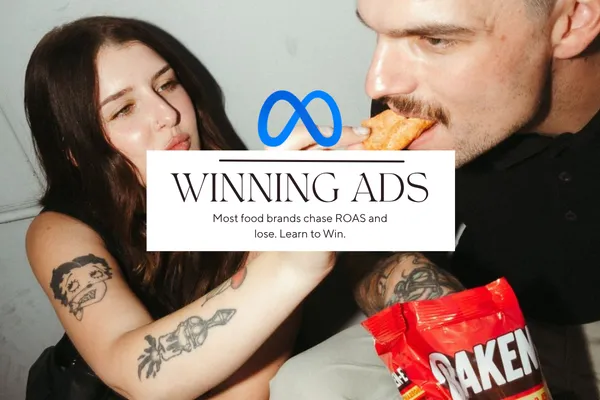
How to Make Winning Meta Ads for Food & Snack Brands
Your Food Brand's Meta Ads Are Probably "Working" and That's Exactly the Problem
Most snack brands running Meta ads think they have a winner when they see a 3.5 ROAS. I get it. The number looks good. The dashboard is green. You scale.
Then 90 days later you wonder why your business isn't growing.
Here's what actually happened: you optimized for a metric that doesn't care whether your customer ever buys again. And in food — where repeat purchases, bundles, and subscriptions are the whole game — that mistake is fatal.
A winning Meta ad for a snack brand is not the one with the highest ROAS. It's the one that acquires customers at a cost your business model can survive, and ideally thrive on, over time. That definition changes everything about how you run your account.
Define the Win Before You Spend a Dollar
Before you touch creative, before you pick an audience, you need one number: your max CAC.
Take your average order value. Subtract COGS, shipping, and transaction fees. What's left is the ceiling. Any ad spending more than that ceiling to acquire a customer is bleeding you out, regardless of what the dashboard says.
For most snack brands, AOV is modest — $30 to $60 on a first order. That means your margin for error is thin. You cannot afford to run ads that feel good. You need ads that hit specific thresholds.
The 30-day LTV:CAC target is where you start. If a customer buys a $45 snack box and you net $18 after costs, your max 30-day CAC is $18. Any ad acquiring customers at or below that number is a candidate for scaling. This matters because 30 days maps to one credit card cycle — you can reinvest before cash gets tight.
But 30 days is just the floor. If your brand has subscriptions, bundles, or any meaningful repeat purchase rate, you should also be tracking LTGP:CAC — lifetime gross profit relative to acquisition cost. An ad that looks like a loser at 30 days can be your most profitable asset at 90. You need to know the difference before you kill it.
What "Winning Creative" Actually Means for Food Brands
Food is visceral. People buy snacks because something in an image or video triggered a craving. Your creative job is simple: make someone want to eat that right now.
That's it. Not "build brand awareness." Not "tell your origin story." Make. Them. Hungry.
The brands that fail at this treat their ads like product listings. Clean white background. Logo. Price. No soul. Nobody's mouth waters at a product listing.
The brands that win show texture. Close-up of a cookie breaking apart. Melted chocolate pulling away from a bar. Crunch sounds on a video. These aren't aesthetic choices — they're conversion mechanisms. When your creative triggers a physical response, your CTR climbs and your CPA drops. That is the relationship.
For format: stop overthinking it. I've seen static images with a single tight food shot outperform 60-second brand videos. I've seen UGC of someone eating out of a bag in their car beat a polished studio shoot. Format is a delivery vehicle. Message is what converts. Test both, but never confuse them.
Three Ad Angles That Work for Snack Brands (And Why)
The first is the craving hook. Open with the product in the most appetizing state possible. No voiceover, no text overlay, just five seconds of something that looks incredible. Then hit them with a reason to buy now — a bundle offer, a limited flavor, a discount on first order. This works because it bypasses rational decision-making entirely. The craving does the selling.
The second is the ingredient story. This works especially well for better-for-you snacks. You're not selling chips, you're selling the fact that your chips don't have the garbage that the other ones do. Lead with what's not in the product. "No seed oils. No artificial anything. Just cassava and sea salt." Short, declarative, easy to process while scrolling. This angle attracts a buyer who will pay more and return more often.
The third is the social proof angle. Not just five-star review screenshots — those are wallpaper at this point. Real UGC, real reactions, real people talking about the specific thing they love. "I've eaten half the bag already" lands harder than "Amazing product, 5 stars." The specificity is what makes it believable.
Testing Isn't Random. It's a System.
Most food brands test the wrong things. They swap out backgrounds. They try different music. They change the logo placement. None of that moves the needle.
What moves the needle: the hook and the offer. Those are the two variables worth testing aggressively.
The hook is the first three seconds of video or the first thing someone reads in a static ad. If your hook doesn't stop the scroll, nothing else matters. Test a sensory hook against a benefit hook against a curiosity hook. Run them to the same offer, same audience, same budget. Let the data pick the winner.
The offer is what you're asking them to do and what they get. A 15% discount versus a free shipping threshold versus a bundle deal will produce wildly different CPAs and — importantly — different customer quality. A buyer who came in on a deep discount is a different customer than one who paid full price for a bundle. Track them separately.
Set a spend threshold before you evaluate. For most snack brands at moderate AOV, that's $150 to $200 per ad before you make a call. Anything less and you're reading noise. Anything more and you're wasting budget on losers.
Scaling Is Not the Reward for a Good Ad. It's a Test.
A lot of brands treat scaling like graduation. The ad worked, now you scale and collect. It doesn't work that way.
When you increase spend, Meta shows your ad to a broader audience. The people who see it at $300 a day are not the same people who saw it at $50. Some ads hold their CPA at scale. Many don't. You need to know which kind you have before you commit budget.
The way you find out is methodical: increase budget 20% every two to three days. Watch CPA, not ROAS. If CPA holds within 15% of your target threshold, keep going. If it blows out, pull back and diagnose — is it the audience saturation, the offer, or the creative wearing out?
For food brands specifically, creative fatigue hits fast. Snack audiences are large but the impulse window is short. A single winning creative might run hard for three weeks before frequency kills it. Build a creative pipeline, not a winning ad. The goal is a system that produces winners consistently, not one hero ad you're praying holds forever.
The Only Thing That Matters at the End
Predictable customer acquisition. That's it. Not viral moments. Not impressive click-through rates. Not a campaign that your team is proud of.
If you know your max CAC, you know what a winning ad looks like. If you know your LTGP, you know which ads to trust at scale. If you have a creative testing system, you're never dependent on one ad surviving forever.
Every snack brand running Meta ads is competing for the same scroll. The ones who win aren't the ones with the best creative. They're the ones who know their numbers, test with discipline, and scale only what the economics justify.
Get clear on that, and the ads almost write themselves.