
Creating and Growing a Brand New Food Brand Online
is Incredibly Difficult.
Learn meta ads -
sell online.







About Us
Two Decades of
Food Sales
I started my first food brand in 2005.
Back then, there were no real systems—if you wanted sales, you showed up. Farmers markets, small retailers, local events. I was loading coolers at 5am, setting up tables, and learning one thing fast:
people don’t buy what they say they like—they buy what makes them act.
From there, I started and sold three more brands.
I stopped focusing on the product and started focusing on behavior. What actually drives someone to choose one option over another. I’ve worked with hundreds of founders since.
The ones who understand buying behavior win.
Online ordering has changed a lot, but it hasn't changed that. This is how I have transitioned to a life dependent on Meta ads.
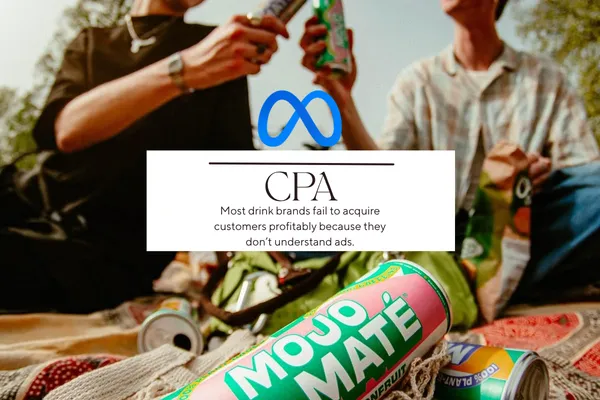
Failing to Acquire Customers For Your Drink Brand? Fix This.
Your Drink Brand's CPA Problem Isn't a Budget Problem
Most drink brands running Meta ads think they need to spend more to win. They're wrong. The issue isn't the budget. It's that the ads themselves are bad — and spending more on bad ads just loses money faster.
I know that sounds obvious. But watch how many brands still try to fix their CPA by adjusting bids, tweaking budgets, or reshuffling audiences. They're pulling levers that don't connect to the actual problem. Your CPA is downstream of everything else. If you want to fix it, you have to work upstream.
The Chain Most Brands Ignore
Here's the chain that actually determines what you pay to acquire a customer:
CTR → CPC → CPA.
CTR tells you whether your ad is relevant to the person seeing it. CPC is just what that relevance costs you inside the auction. CPA is the business outcome of both. You don't fix CPA by touching CPA. You fix it by improving what's above it in the chain.
I was running ads for an e-commerce store a couple of years back. The product was $29.99 with a solid backend, and the unit economics looked fine on paper. But some days I was paying $75 to acquire a customer. That's a death sentence for most DTC margins. When I went looking for the problem, I wasn't looking at CPA — I was looking at why no one was clicking.
The creative was product-first. It showed the item, explained what it did, and assumed people would connect the dots. They didn't. CTR was low. And because CTR was low, the auction penalized me with higher CPMs, which crushed CPC, which wrecked CPA. Once I switched to problem-first messaging — leading with the pain the person was already feeling — CTR went up, CPC dropped, and CPA followed. Nothing about the bid changed. The audience didn't change. Just the ad.
That's the whole lesson. But for drink brands, it goes deeper.
Why Drink Brands Specifically Struggle With This
Drink brands love showing the product. Beautiful can, good lighting, someone laughing at a rooftop party. It looks premium. It photographs well. And it almost never works as a direct-response ad.
Here's why: your customer isn't scrolling Instagram thinking about their next beverage purchase. They're not in "shopping mode." They're half-watching a video of someone's dog. You have about two seconds to interrupt that. A glamour shot of your packaging doesn't interrupt anything — it just blends into the feed.
What interrupts is a problem they already feel. The 3pm energy crash. The bloated feeling after soda. The person who wants to drink something at a party without it being alcohol or a sad glass of water. If your hook doesn't speak to one of those moments, your CTR will be low. If your CTR is low, your CPC will be high. If your CPC is high, your CPA will kill you.
This is message-market fit. And in the drink space, you have an enormous advantage — because the problems your product solves are visceral, daily, and emotional. You just have to use them.
What to Actually Fix First
Start with CTR. Not CPC. Not CPA. CTR is the first signal that something is working or broken.
If your CTR is below 1% on cold traffic, the ad isn't resonating. Full stop. No amount of audience tweaking will fix a bad hook. What you need is a stronger, more specific message. Pick one person — one real customer — and write the ad for them. Name their specific frustration. Speak to the moment they reach for your product. "You're three meetings deep and running on nothing" lands harder than "Feel the energy."
Specificity is what separates a 0.6% CTR from a 2% CTR. And in the Meta auction, that difference is massive. Higher CTR means the platform rewards you with lower CPMs. Lower CPMs mean lower CPC. Lower CPC — assuming your landing page and offer aren't broken — means lower CPA. The whole chain improves from one change at the top.
Once CTR is moving, watch CPC. If CTR climbs but CPC doesn't budge, you've got a CPM problem — usually a sign the audience is oversaturated or the engagement signals are weak. This is rarer, but it means you need to either open the targeting or refresh the creative more aggressively. Drink brands are particularly vulnerable to creative fatigue because the audience sizes for targeted wellness or better-for-you consumers are smaller than general retail.
CPA is the last thing you look at. If CTR is strong, CPC is efficient, and CPA is still off, the problem is the landing page or the offer — not the ad. Maybe the price point is too high without enough social proof. Maybe the bundle isn't obvious. Maybe the subscribe-and-save option is buried. But you only go diagnose that after you've confirmed the ad layer is working.
The Angles That Actually Move CTR for Drink Brands
This is where execution lives. Here are the three creative angles that consistently drive high CTR for drink brands in cold traffic:
Problem-state hooks. Lead with the moment your customer is in right before they need your product. "3pm and you've got two more hours left." "Trying to cut back on alcohol but water feels like giving up." "You're bloated every time you drink soda and you're tired of it." These hooks stop the scroll because they're describing a lived experience.
Ingredient transparency. Consumers are more skeptical than ever. "What's actually in this?" is a question they're asking silently every time a new drink brand shows up in their feed. Ads that lead with what's not in the product — no artificial sweeteners, no sugar crash, no junk — consistently outperform pure benefit claims in testing. It builds trust before the ask.
Side-by-side comparison. Your product vs. the thing it's replacing. Energy drink vs. your drink. Afternoon coffee vs. your product. This format works because it's doing the customer's mental work for them. They don't have to figure out the use case. It's right there. And it triggers the craving in the right context.
Test all three. Don't fall in love with one angle before the data tells you to.
The Testing Framework
Run three to five creatives per angle. Keep everything else constant — same audience, same offer, same landing page. You're isolating the variable. The question you're answering is: which hook resonates most?
Let each creative hit at least 1,000 impressions before drawing conclusions. Look at CTR first. Then look at CPC. Kill anything that's pulling your average down. Double down on what's working by making more variations of that angle — different visual formats, different hooks within the same frame, UGC versus produced content.
The goal in testing phase is not to find a winner and scale. It's to understand why something is winning. Once you know that, you can make ten more ads in that vein without starting from scratch every time.
Scaling Is a Creative Problem Too
Most drink brands think scaling means increasing budgets. It means increasing creative output. An ad that's performing at $500/day will fatigue at $5,000/day — usually faster than you expect. The audience size for a specific drink niche is limited, which means you'll cycle through your best audience faster than a general consumer brand would.
The brands that scale successfully on Meta have a creative pipeline, not just a winning ad. They're producing three to five new pieces of content per week. They're testing new hooks constantly. They're treating the creative operation like a production studio, not a one-time project.
Your CPA will stay low at scale if and only if your CTR stays strong. And CTR stays strong only if you keep feeding fresh creative into the system. The math is simple. The execution is the hard part.
Closing: Build the System, Not Just the Ad
Your CPA is not a mystery. It's a reflection of how well your message fits your market, measured in real time by the platform every time someone scrolls past your ad or stops to click it. If the number is too high, go back to the beginning of the chain. Fix the hook. Fix the message. Fix the relevance.
Stop trying to engineer the output. Engineer the inputs.
Drink brands have an enormous creative advantage — the product is visual, the use cases are emotional, and the moments people reach for a drink are deeply human. Use that. Build ads that enter the conversation already happening in your buyer's head. Watch what CTR does. Then let the chain do its job.
Predictable customer acquisition on Meta isn't complicated. It's just disciplined.