Creating and Growing a Brand New Food Brand Online
is Incredibly Difficult.
Learn meta ads -
sell online.


About Us
Two Decades of
Food Sales
I started my first food brand in 2005.
Back then, there were no real systems—if you wanted sales, you showed up. Farmers markets, small retailers, local events. I was loading coolers at 5am, setting up tables, and learning one thing fast:
people don’t buy what they say they like—they buy what makes them act.
From there, I started and sold three more brands.
I stopped focusing on the product and started focusing on behavior. What actually drives someone to choose one option over another. I’ve worked with hundreds of founders since.
The ones who understand buying behavior win.
Online ordering has changed a lot, but it hasn't changed that. This is how I have transitioned to a life dependent on Meta ads.
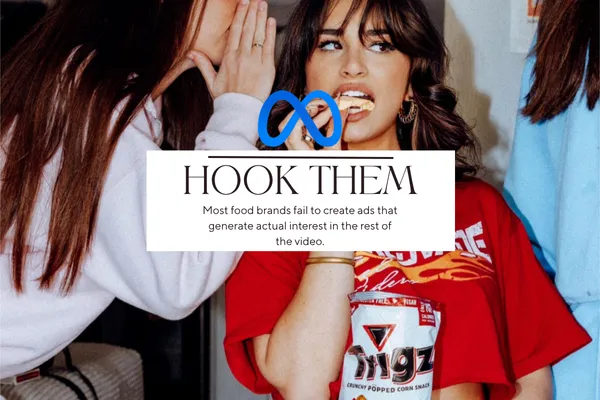
Your Snack Brand Will Never Perform Without a Great Hook
Why Your Snack Brand's Meta Ads Are Being Ignored Before Anyone Even Reads Them
Most food brands blame the product when their Meta ads don't convert. Wrong product-market fit, they say. Wrong audience. Wrong season. I've seen brands with genuinely incredible products — a small-batch hot honey brand out of Nashville, a protein chip company with a legitimately better formula than anything on shelves — spending $5,000 a month on ads that nobody read past the first line. The product wasn't the problem. The hook was.
Here's the thing about paid social that took me longer than I'd like to admit to really internalize: you are not advertising on a platform where people came to see your ad. They came to see a video of their cousin's dog. Your ad has to earn its place in that feed in about 1.5 seconds, or it's dead. Not underperforming. Dead. The scroll moves on, the impression is gone, and you paid for it anyway.
The Real Problem: You're Writing for Packaging, Not for Feeds
Walk through a Whole Foods and notice how snack brands write their copy. It's all benefit-forward, vibe-coded, identity-driven. "Bold flavors. Clean ingredients. No compromises." That language works on a shelf where someone's already holding your bag. On Meta, nobody's holding anything. They're moving fast, they're distracted, and they don't know you exist yet.
I was helping a nut butter brand restructure their ad account last year. Their creative looked beautiful — lifestyle photography, clean fonts, gorgeous food styling. Their hook was: "Crafted with real ingredients for real people." CTR was 0.4%. We rewrote the hook to: "Most nut butters have more sugar than a candy bar. Ours has none." Same creative, same audience, same budget. CTR went to 1.8%. The principle that came out of that is simple: relevance beats aesthetics, every time, at the top of the funnel.
Your hook isn't branding. Your hook is a targeting mechanism. The right hook repels the wrong buyer and magnetizes the right one before they even see your offer.
What a Food Brand Hook Actually Needs to Do
A good hook for a snack or food brand has one job: make the right person stop and feel understood. Not impressed. Not entertained. Understood. If someone reads your first line and thinks "wait, that's me," you've won the attention auction. Everything after that — your creative, your offer, your CTA — gets a fighting chance.
That requires three things compressed into one line. It needs to speak to a real, specific problem or desire your buyer already has. It needs to carry some specificity — a number, a scenario, a contrast — because vague hooks feel like every other ad. And it needs to imply that what follows is worth two more seconds of their time.
Here are the hook structures that actually work for food brands on Meta, in order of how I've seen them perform:
Problem-Recognition Hook: "You've been buying protein bars that taste like chalk. There's a better option now." This works because it names a frustration the buyer already carries. They don't need convincing — they've already lived it.
Contrarian Hook: "Eating healthy doesn't mean paying $8 for a bag of air and almonds." This creates tension immediately. Tension is scroll-stopping. And in the snack space, price-value tension is very real for a lot of buyers.
Specificity Hook: "This snack has 22g of protein, 4g of net carbs, and actually tastes like food." Numbers create credibility without asking the reader to trust you first. In food, where skepticism is high and the category is crowded, that matters.
Identity Hook: "If you take your macros seriously, this is the only protein chip worth buying." This one qualifies and flatters simultaneously. The reader either self-selects in or moves on — both outcomes are useful.
The Testing Framework: How to Find Your Winner
Most food brands test creatives like they're buying lottery tickets. They launch five different videos with five different hooks, let them run until budget runs out, and declare a winner based on whoever spent the least on a purchase. That's not testing. That's hoping.
Real hook testing starts with isolation. Same creative, same offer, same audience — change only the first line. You're not testing videos. You're testing sentences. Run 3 to 5 hook variations per creative, give each one enough impressions to produce statistically meaningful engagement data (usually 2,000 to 3,000 impressions minimum), and use CTR as your primary sorting signal before you look at CPA. Low CTR tells you the hook failed. High CTR with low conversion tells you the hook over-promised or pulled the wrong buyer. Both are data. Neither is failure.
The specific metrics I look for: any hook above 1.5% CTR on cold traffic is worth advancing to the offer level. Anything below 0.8% gets cut. The middle range — 0.8% to 1.5% — usually means the hook has the right idea but needs a sharper opening word or a more specific scenario. I'll often rewrite those rather than kill them entirely.
Scaling Logic: When to Refresh, When to Push
Here's what most brands miss when a hook starts working. They scale the budget and ride it until it dies. Then they wonder why their CPA tripled over six weeks. Ad fatigue on Meta is real, and it's faster than most people expect — especially in food categories where audiences are relatively tight and browsing behavior is high-frequency.
The rule I use: once your frequency passes 3.0 on a winning ad set and CTR starts declining week-over-week, introduce a new hook variant — not a new creative, a new hook. You can often extend the life of a top-performing creative by 3 to 4 weeks just by swapping the first line. That buys you time to shoot new creative without letting your CPA spike while you wait for it.
The deeper principle is this: your hook is not a one-time decision. It's an ongoing creative variable that you manage actively, just like your audience targeting or your bid strategy. Food brands that treat it that way — that maintain a running bank of tested hooks organized by angle and performance — consistently outperform brands that treat creative as something you produce once and run until it dies.
Start Here
If you're running Meta ads for a snack or food brand and your CTR is below 1%, your hook is the first thing to fix. Before you change your audience. Before you shoot new creative. Before you adjust your offer.
Write five new hook variations based on the structures above — one problem-recognition, one contrarian, one specificity-driven, one identity-driven, and one that names a competitor category without naming a brand. Test them against your existing control. Read the CTR data at 3,000 impressions per variant. Advance the two best into full creative testing.
That's the work. It's not complicated. It's just specific. And specific is what gets paid attention to in a feed full of noise.