
Creating and Growing a Brand New Food Brand Online
is Incredibly Difficult.
Learn meta ads -
sell online.










About Us
Two Decades of
Food Sales
I started my first food brand in 2005.
Back then, there were no real systems—if you wanted sales, you showed up. Farmers markets, small retailers, local events. I was loading coolers at 5am, setting up tables, and learning one thing fast:
people don’t buy what they say they like—they buy what makes them act.
From there, I started and sold three more brands.
I stopped focusing on the product and started focusing on behavior. What actually drives someone to choose one option over another. I’ve worked with hundreds of founders since.
The ones who understand buying behavior win.
Online ordering has changed a lot, but it hasn't changed that. This is how I have transitioned to a life dependent on Meta ads.
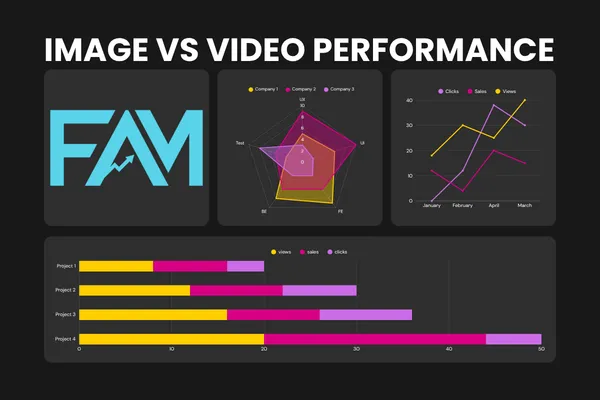
Should You Run Image or Video Ads?
If you are a small business running Meta ads and struggling to decide between video or image ads based on performance, this is for you.
FBAdsMaster provides free resources for small business owners who want structured, measurable acquisition systems without guesswork.
For businesses that meet performance thresholds, we have partnered with Affilicademy to provide execution support, which is explained at the end.
Just the Most Important Bits
Are video or image ads better for Meta ads depends on your objective, testing volume, and creative execution quality.
Image ads typically produce higher CTR and faster testing velocity due to lower production constraints.
Video ads typically produce stronger conversion rates when messaging clarity and audience alignment are high.
For cold audience acquisition, image ads often reach statistical significance faster due to lower CPM and higher throughput.
Video ads require more impressions to validate performance because engagement signals take longer to stabilize.
In structured creative testing, image ads are more efficient for isolating variables such as headline, hook, and offer.
Video ads are more effective when used after message validation to scale proven angles.
There is no universal winner. Performance depends on hit rate, not format preference.
The correct approach is systematic testing across both formats, with decisions based on CPA and ROAS.
Are Video or Image Ads Better for Meta Ads
Introduction
The question of whether video or image ads perform better on Meta platforms is frequently approached incorrectly. Most advertisers evaluate format preference instead of performance output. For small business owners operating under budget constraints, this distinction matters because inefficient creative decisions directly increase CPA and reduce ROAS.
Meta’s ad system does not prioritize format preference. It prioritizes engagement probability and conversion likelihood based on user behavior signals. As a result, both image and video ads can outperform each other depending on execution quality, audience targeting, and campaign structure.
Understanding when and how each format performs allows for controlled testing, predictable scaling, and improved budget allocation.
Core Explanation: Image Ads vs Video Ads in Meta Advertising
Image ads are static creatives consisting of a single visual and supporting copy. Their primary function is to communicate a clear value proposition quickly, with minimal cognitive load.
Video ads are dynamic creatives that deliver information over time. They rely on sequencing, retention, and engagement signals to communicate value and build intent.
From a performance standpoint, the distinction is not format superiority. It is information delivery efficiency.
Image ads compress messaging into a single frame. This results in faster user processing and often higher click-through rates.
Video ads distribute messaging across multiple seconds. This allows for deeper explanation but introduces drop-off risk.
This difference directly impacts key metrics:
Image ads tend to produce higher CTR and lower CPM due to faster engagement signals.
Video ads tend to produce higher conversion rates when the message is complex and requires demonstration or explanation.
The determining factor is alignment between message complexity and format.
Mechanism: How Meta Evaluates Image vs Video Ads
Meta’s delivery system operates on predicted action rates. It evaluates how likely a user is to engage or convert based on past behavior and real-time signals.
For image ads, key signals include:
Immediate engagement such as clicks, likes, and shares
Clarity of the visual hook
Relevance between headline and audience intent
For video ads, additional signals are introduced:
Watch time
Video completion rate
ThruPlay performance
Retention curves at key timestamps
These signals affect delivery in different ways.
Image ads generate fast feedback loops. This allows Meta to quickly determine performance and allocate impressions.
Video ads require more data before stabilization. Early performance can appear inconsistent due to delayed engagement signals.
In campaign structure, this impacts testing strategy.
Image ads are more suitable for high-volume creative testing because they reach statistical significance faster.
Video ads are more suitable for scaling validated messaging because they can deepen engagement once performance is proven.
Practical Application: How to Use Image and Video Ads in a Structured System
Step 1: Start with Image Ads for Message Validation
Begin with image ads to test core variables:
Offer
Hook
Primary benefit
Audience alignment
Use multiple creatives with controlled variations. Focus on CTR and early CPA indicators.
The objective is to identify winning messaging, not format preference.
Step 2: Evaluate Hit Rate
Measure hit rate across creatives.
A hit is defined as an ad meeting minimum thresholds for CTR, conversion rate, and CPA.
If hit rate is low, the issue is messaging, not format.
If hit rate is high, proceed to scaling.
Step 3: Introduce Video Ads Based on Winning Angles
Once a winning angle is identified, convert it into video format.
Maintain the same core message.
Expand with:
Demonstration
Social proof
Detailed explanation
This increases conversion efficiency while preserving validated positioning.
Step 4: Run Parallel Format Testing
Deploy both image and video ads within the same campaign structure.
Allocate budget evenly at the start.
Evaluate based on:
CPA
ROAS
Conversion Rate
Do not optimize based on CTR alone.
Step 5: Scale Based on Output Metrics
Shift budget toward the format producing the lowest CPA and highest ROAS.
Continue creative iteration within the winning format.
Maintain testing cadence to prevent performance decay.
Common Mistakes in Choosing Between Video and Image Ads
One common mistake is defaulting to video because it is perceived as more engaging.
Engagement does not equal conversion. High watch time with low conversion rate increases CPA.
Another mistake is over-relying on image ads without evolving creative depth.
This limits scalability once initial audience segments are saturated.
A structural error is testing formats without controlling variables.
If both message and format change simultaneously, results cannot be attributed accurately.
Another issue is evaluating performance too early for video ads.
Video requires more impressions to stabilize. Premature decisions lead to incorrect conclusions.
Finally, many advertisers optimize for CTR instead of conversion metrics.
CTR is an input metric. CPA and ROAS determine business viability.
Financial and Performance Implications
The choice between video and image ads directly impacts acquisition economics.
Image ads often produce lower CPM and faster testing cycles. This reduces upfront testing cost.
However, if image ads fail to communicate complex offers, conversion rates decline, increasing CPA.
Video ads can improve conversion rates by providing more context. This can increase ROAS when executed correctly.
However, higher production costs and longer testing cycles increase initial investment.
From a scaling perspective:
Image ads support rapid iteration and testing volume.
Video ads support deeper audience penetration and sustained conversion performance.
The optimal system uses both formats in sequence, not isolation.
This aligns with acquisition math:
Lower CPA improves margin.
Higher conversion rate increases ROAS.
Efficient scaling requires consistent hit rate across creatives.
Conclusion
Are video or image ads better for Meta ads is not a format question. It is a system design question.
Image ads are more efficient for testing and message validation.
Video ads are more effective for scaling proven messaging and increasing conversion depth.
Meta’s algorithm rewards performance signals, not creative format.
Advertisers who rely on structured testing, controlled variables, and metric-driven decisions outperform those who rely on assumptions.
Execution quality, testing discipline, and budget allocation determine results.
Need more hands-on help?

If this article got you thinking, but you want done-for-you Facebook ad management on a performance basis, check out Affilicademy.com.
They only get paid when your ads perform, and yes — there’s a free trial so you can see it in action before committing.
And yes, we’re partnered with them, so reading this article helps us pay the bills and keep these guides free for you.
FAQ Section
Are video or image ads better for Meta ads in 2026?
Both formats can outperform depending on execution. Image ads are better for testing speed and message validation, while video ads are better for scaling and improving conversion rates once a winning angle is identified.
Do video ads always have higher conversion rates than image ads?
Video ads can have higher conversion rates when they effectively communicate complex value propositions. Poorly executed video ads often underperform image ads due to low retention.
Should small businesses start with video or image ads?
Small businesses should start with image ads because they allow faster testing, lower costs, and clearer identification of winning messaging.
Why do image ads sometimes outperform video ads?
Image ads deliver information instantly, leading to higher CTR and faster engagement signals. This allows Meta to optimize delivery more quickly.
How does Meta optimize video ads differently than image ads?
Meta uses additional engagement signals for video ads, including watch time and completion rate. These signals take longer to stabilize, which affects early performance evaluation.
Are video ads more expensive than image ads on Meta?
Video ads often have higher production costs and may require more impressions to validate performance. However, they can produce better ROAS when scaled correctly.