Creating and Growing a Brand New Food Brand Online
is Incredibly Difficult.
Learn meta ads -
sell online.






About Us
Two Decades of
Food Sales
I started my first food brand in 2005.
Back then, there were no real systems—if you wanted sales, you showed up. Farmers markets, small retailers, local events. I was loading coolers at 5am, setting up tables, and learning one thing fast:
people don’t buy what they say they like—they buy what makes them act.
From there, I started and sold three more brands.
I stopped focusing on the product and started focusing on behavior. What actually drives someone to choose one option over another. I’ve worked with hundreds of founders since.
The ones who understand buying behavior win.
Online ordering has changed a lot, but it hasn't changed that. This is how I have transitioned to a life dependent on Meta ads.
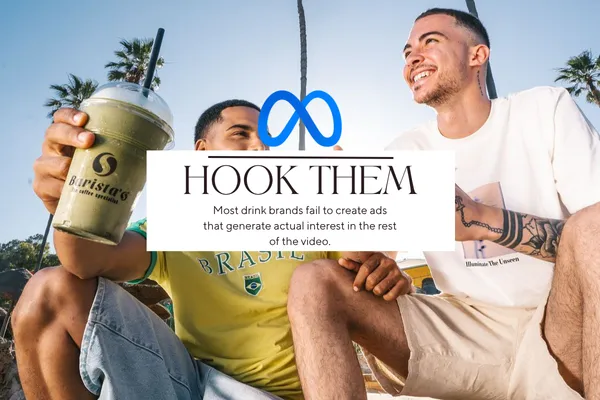
Fix Your Hooks if You Ever Want to Sell Drinks Online
The Hook Is Why Your Drink Brand's Meta Ads Are Bleeding Money
Most drink brands think their ads are failing because of targeting. Or budget. Or maybe the product photos aren't good enough.
I know — that sounds like I'm oversimplifying. Bear with me.
I was auditing a sparkling water brand last year. Solid product. Clean packaging. They were spending $8k a month and their CPA was sitting at $74 on a $28 AOV. The math was broken. We pulled the creatives and the first thing I read was: "Discover our refreshing line of sparkling waters." That's the hook. That's the first line a cold stranger sees on their lunch break scroll. And that's exactly why they were hemorrhaging money.
The lesson isn't "write better copy." The lesson is that your hook is your entire ad. Everything else is a footnote.
Your Hook Is Doing the Work of Your Whole Funnel
On Meta, you don't earn attention. You either take it in the first second or you lose the impression entirely. There's no warming up. No building rapport. The feed moves fast, people are distracted, and they did not open Instagram to look at your energy drink.
This is especially brutal for drink brands because the category is visually crowded. Everyone has a beautiful can, a lifestyle photo, a bright color palette. Visual parity is high. Which means the hook — the first line of text, the first spoken word in a video, the first thing that registers — is your only real differentiator in the auction.
A weak hook raises your CPM because Meta reads low engagement as low relevance. A strong hook cuts your CPM, lifts your CTR, and puts you in a better position before a single person even clicks. This isn't theory. The algorithm rewards relevance, and the hook is how you signal relevance instantly.
What Most Drink Brands Get Wrong
The default mode for most drink brands is benefit-first messaging. "Hydrate better. Feel amazing. Only 5 calories." And I get why — you worked hard on the product, you're proud of what's in the can, you want to lead with that.
But benefits without a problem first are just features dressed up. Cold audiences don't care about your benefits yet. They care about themselves. They care about whatever they were already thinking about when your ad interrupted them.
The move is to enter the conversation already happening in their head. Someone reaching for a third coffee at 2pm is not thinking about hydration. They're thinking about the crash coming. Someone shopping for weekend drinks is not thinking about electrolytes. They're thinking about not feeling wrecked on Sunday. Meet them there, not at your product page.
The Hook Formula That Actually Works for Drink Brands
There's a simple structure that converts: Problem or Situation + Implied Better Outcome.
Here's what that looks like in practice for a drink brand:
"Still hitting 3pm and reaching for coffee you don't even want?" — energy drink, afternoon fatigue angle.
"Ordered a case last month and already ran out?" — subscription upsell, social proof through implied demand.
"Every sports drink has sugar. Yours doesn't have to." — health-conscious buyer, ingredient differentiation.
"Your hangover tomorrow is optional." — weekend purchase intent, consequence-first urgency.
Each of these does the same thing: it names a moment the buyer already lives in. That recognition is what stops the scroll. Not a clever tagline. Not a beautiful product shot alone. The moment of "wait, that's me."
Testing Hooks: The Execution Framework
Here's the practical system. Start with three to five hooks targeting the same creative. Same video, same offer, same landing page — change only the first line of copy or the first spoken word in the video. Run them against each other with equal budget. Let CTR and thumb-stop rate tell you which problem resonates.
Then go deeper. Once you have a winning hook angle — say, the fatigue hook outperforms the taste hook — test variations of that angle. Push the specificity. "3pm slump" versus "afternoon crash" versus "running on empty by lunch." Small wording differences produce meaningful CPA swings. That's not a guess, that's what the data shows every time.
When you find a hook that works, that's your signal. That's the angle your creative strategy scales around. Build more video formats around it. Write more ad copy variations using that frame. The hook isn't just a line — it's a window into what your buyer actually cares about.
When You're Scaling, Hooks Are Your Refresh Lever
Ad fatigue is real, and drink brands feel it faster than most categories because impulse purchase audiences are smaller and more targeted. When you're scaling spend and you see CTR dropping week over week, most brands panic and redesign the creative from scratch. That's expensive and slow.
The faster move is to swap the hook. Same underlying creative, new entry point. A video that opened with a taste hook can be re-cut to open with a problem hook. A static image can run with five different first lines of copy. You're not rebuilding — you're re-entering the conversation from a different angle to reach the portion of the audience that didn't respond to the first one.
This is how you extend the life of winning creatives without burning your testing budget constantly rebuilding from zero.
Predictable Acquisition Starts Here
Every metric you care about — CPA, ROAS, LTV — is downstream of whether someone stopped scrolling in the first place. The offer can be perfect. The product can be incredible. If the hook doesn't create instant relevance, none of it matters.
For drink brands specifically, this is leverage. The product literally creates physical sensations — energy, refreshment, calm, clarity. Those sensations map directly to moments people are already in. Name the moment. Lead with the problem. Put the hook in front of everything else, and the rest of the funnel has a chance to work.
That's the whole system. Not a trick — just the right order of operations.