
Creating and Growing a Brand New Food Brand Online
is Incredibly Difficult.
Learn meta ads -
sell online.








About Us
Two Decades of
Food Sales
I started my first food brand in 2005.
Back then, there were no real systems—if you wanted sales, you showed up. Farmers markets, small retailers, local events. I was loading coolers at 5am, setting up tables, and learning one thing fast:
people don’t buy what they say they like—they buy what makes them act.
From there, I started and sold three more brands.
I stopped focusing on the product and started focusing on behavior. What actually drives someone to choose one option over another. I’ve worked with hundreds of founders since.
The ones who understand buying behavior win.
Online ordering has changed a lot, but it hasn't changed that. This is how I have transitioned to a life dependent on Meta ads.
Acquire Customers For Your Perfume Brand Profitably
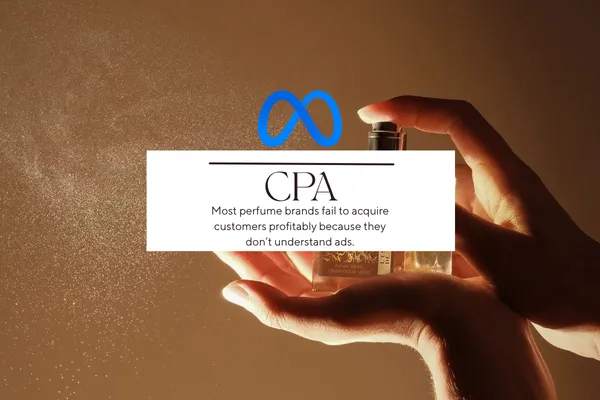
Your Perfume Brand's CPA Problem Isn't a Budget Problem
Most perfume brands think they're losing on Meta because they're not spending enough. Throw more money at the campaign, they say. Raise the budget, broaden the audience, test a new interest stack. I know that feels logical. Bear with me — it's the wrong diagnosis almost every time.
Your CPA is not a budget problem. It's a creative problem. And until you fix the creative, you're just scaling a leak.
The Chain Most Brands Never See
Here's the relationship that changes everything once you actually internalize it.
Your CPA is downstream from your CPC. Your CPC is downstream from your CTR. Your CTR is downstream from your ad — the hook, the visual, the message, the person you're speaking to. Every number in your account is just a reflection of how well your creative resonates with the right buyer. That's it. That's the whole game.
I've watched perfume brands dump $5,000 into campaigns with a 0.4% CTR and wonder why their CPA is $80. The answer is obvious from the outside. The ad isn't stopping anyone. People are scrolling past it at full speed, Meta is charging a premium to keep showing it, and the math never works. You can't bid your way out of a bad ad. The algorithm rewards engagement, and engagement comes from relevance.
When your ad is relevant — genuinely relevant, not just pretty — CTR climbs. When CTR climbs, CPC drops because you're getting more clicks per dollar spent on impressions. When CPC drops with a stable conversion rate, CPA falls. You didn't touch the budget. You just made a better ad.
Why Perfume Brands Specifically Get This Wrong
Perfume is a sensory product being sold on a visual platform. That tension creates a very specific failure mode: brands default to aesthetic-first creative. Gorgeous product shots. Moody lighting. A model in a field. Beautiful, sure. But beautiful doesn't explain why someone should stop scrolling and buy.
The question your creative needs to answer in the first two seconds is not "does this look luxurious?" It's "is this for me?" Those are completely different questions, and most perfume ads answer the first one while ignoring the second.
I tested this directly with a fragrance client earlier this year. We had two creatives running. One was a high-production lifestyle video — soft focus, slow motion, the whole thing. The other was a UGC clip of someone saying, "I've been wearing this to the office every week and three people have stopped to ask what I'm wearing." The lifestyle video had a 0.6% CTR. The UGC clip hit 2.1%. Same product. Same audience. Different message. The UGC ad was speaking to a specific desire — social recognition, the compliment loop — and the lifestyle ad was just looking good.
That CTR gap translated directly into a $34 difference in CPA. Not because we changed the offer or the landing page. Because one ad stopped the scroll and one didn't.
Message-Market Fit Is the Only Lever That Matters First
Before you think about scaling, before you think about lookalikes, before you think about campaign structure — get your message right.
Message-market fit for a perfume brand means your ad speaks to a specific buyer's specific desire, not to "people who like fragrance." That audience does not exist in a way you can target profitably. What exists are people who want to smell like money, people who want a signature scent they never have to explain, people who are tired of drugstore options, people who buy perfume as self-care, people who are shopping for a partner or occasion. These are different buyers. They respond to different hooks. They convert on different offers.
Here's how to think about this in execution. Pick one ICP — one buyer, one desire, one pain point. Build your hook around that. If you're targeting the "office compliment" buyer, your hook is about social recognition. If you're targeting the "I've never found a scent that felt like me" buyer, your hook is about identity and arrival. If you're targeting the gift buyer, your hook is about confidence and impression. The visual, the voiceover, the first line of copy — all of it should be a direct answer to what that specific person wants.
When you get this right, CTR goes up because the right person feels seen. When the right person feels seen, they click, they land, they buy. The whole funnel tightens because you've stopped wasting impressions on people who were never going to convert.
How to Diagnose Where Your Funnel Is Actually Breaking
Most perfume brands look at CPA and try to fix CPA. That's the wrong place to start. CPA is the result. You can't fix a result directly. You fix the inputs.
Here's the diagnostic sequence. Start with CTR. If your CTR is below 1% on a cold audience, the problem is your creative. Not your audience, not your offer — your creative. The hook isn't landing. The visual isn't stopping the scroll. Build a new ad.
If your CTR is healthy — call it 1.5% or above — and your CPC is still high, check your CPM. A high CPM with decent CTR often means your audience is over-competed or your engagement signals are weak. Try a broader audience or refresh the creative to improve engagement rate, not just clicks.
If CTR and CPC are both solid and CPA is still high, the problem has moved downstream. Now you're looking at landing page alignment — does the page match the promise of the ad? — or offer construction. Is the first purchase compelling enough? Is there a strong enough reason to buy now versus later?
The order matters. You don't diagnose the landing page when the ad is broken. You don't fix the offer when nobody's clicking. Follow the chain from the top.
What Winning Perfume Ad Creative Actually Looks Like
Let me be specific, because this is where most brand-side thinking goes wrong. Winning ad creative for a perfume brand on Meta in 2025 is not a campaign photoshoot. It's a message delivered in a format that feels native to the feed.
The hooks that consistently outperform for fragrance are desire-driven and outcome-specific. "This is the scent people stop and ask about." "I wore this once and now I can't wear anything else." "Finally found a perfume that doesn't disappear in an hour." "My husband thinks I smell like a hotel we stayed at in Paris — this is why." These hooks work because they're specific, they're outcome-oriented, and they immediately communicate who they're for.
Format-wise, UGC and talking-head video outperform lifestyle production for cold audiences at almost every price point I've tested. The reason is trust. A real person holding a bottle and telling you what it smells like — citrus up front, warm base, lasts all day — is more believable than an aesthetic campaign, and believability drives clicks. Save the beautiful production for retargeting, where the person already knows you and you're closing on brand affinity.
Static images still work, but they need to lead with specificity. A clean image of the bottle with "3,000+ five-star reviews" and a hook like "the scent that replaced everything in her cabinet" outperforms a pure aesthetic shot every time. Give the viewer something to respond to, not just something to admire.
The Testing Framework Before You Scale Anything
Scaling a bad ad fast is just a faster way to lose money. Before you think about budget, you need signal. Here's how to build it cleanly.
In your testing phase, run three to five distinct creative angles against the same cold audience, one per ad set or in a structured CBO. Keep spend controlled — you're buying data, not customers. You're looking for CTR differences first. Any creative that pulls above 1.5% CTR on cold deserves a longer look. Anything below 1% after meaningful spend gets cut.
Once you have two or three creatives with strong CTR, look at which ones are also producing the lowest CPC. That's the combination of CTR performance and CPM efficiency that tells you the algorithm likes the ad and the audience is engaging. At that point, look at CPA. If CTR and CPC are strong and CPA is still high, test your landing page or your offer construct — a bundle, a free shipping threshold, a first-order discount. Don't change the ad until you've ruled out the page.
When you find a creative angle that produces a CPA inside your target, that's your signal to scale. Duplicate the campaign, increase budget incrementally — 20% increases every 48 to 72 hours rather than 3x overnight — and start building a pipeline of creative variations around the same winning angle. New hooks, same message. Different formats, same offer. Keep what's working and iterate around it.
The One Number to Protect as You Scale
Ad fatigue is the thing that kills scaling perfume brands more than anything else. You find a winning creative, you scale the budget, it works for three weeks, and then CTR starts dropping, CPC climbs, CPA follows, and you're back to square one. This is normal. It's not a failure — it's the nature of running ads to a finite audience.
The protection against fatigue is creative volume. You need a consistent pipeline of new ads built around your winning angles. Not random experiments — systematic variations. If your winning hook is "the compliment-getter," build five more ads around that concept. Different person, different setting, different words, same underlying message. When one fatigues, the next one is ready.
Your CTR is the early warning signal for fatigue. When CTR starts dropping week over week on a previously strong creative, that's your cue to push fresh variants before CPA climbs. Don't wait for CPA to break before you react. Watch CTR, and act early.
Where This All Points
Predictable customer acquisition for a perfume brand on Meta is not complicated. But it is disciplined.
It starts with knowing your buyer specifically enough to write an ad that makes them feel like it was written for them. It runs through creative that stops the scroll, earns the click, and delivers on the promise of the hook. It scales when you find signal, incrementally, with fresh creative ready to replace fatigue. And it compounds when you understand that every number in your account — CTR, CPC, CPA — is just a reflection of how well your message fits your market.
You don't fix CPA. You fix the ad. The CPA follows.