
Creating and Growing a Brand New Food Brand Online
is Incredibly Difficult.
Learn meta ads -
sell online.










About Us
Two Decades of
Food Sales
I started my first food brand in 2005.
Back then, there were no real systems—if you wanted sales, you showed up. Farmers markets, small retailers, local events. I was loading coolers at 5am, setting up tables, and learning one thing fast:
people don’t buy what they say they like—they buy what makes them act.
From there, I started and sold three more brands.
I stopped focusing on the product and started focusing on behavior. What actually drives someone to choose one option over another. I’ve worked with hundreds of founders since.
The ones who understand buying behavior win.
Online ordering has changed a lot, but it hasn't changed that. This is how I have transitioned to a life dependent on Meta ads.
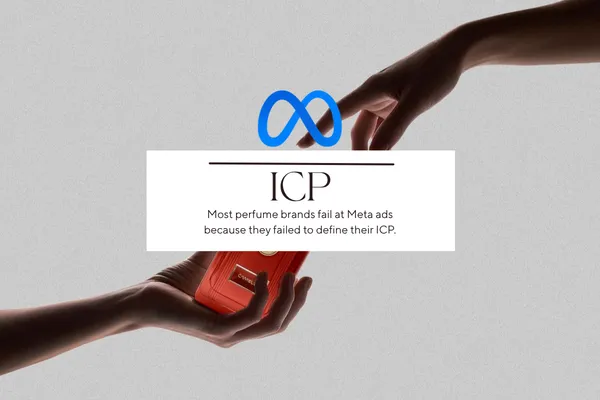
You Need an ICP if You Want to Build a Perfume Brand
Why Your Perfume Ads Are Failing (And It Has Nothing to Do With Your Targeting)
Most perfume brands running Meta ads think their problem is the algorithm. They're wrong.
I know — that sounds backwards. Bear with me.
I was auditing an account for a niche fragrance brand last year. Good product. Genuinely beautiful packaging. They were spending $4,000/month and getting a 1.1x ROAS. The founder kept asking me to fix the targeting. "We need better lookalikes," he said. "Our interests are too broad."
So I looked at the creative. The hook was: "Smell incredible all day."
That's not an ad. That's a category statement. Every perfume brand on the planet is saying the same thing, and Meta's algorithm — as smart as it is — cannot optimize toward buyers when your signal is that weak.
The fix wasn't the targeting. It was the ICP. Once we rebuilt who the ad was actually for, the creative changed, the hook changed, and within three weeks CPA dropped by 40%.
Here's what I learned from that, and what you need to apply right now.
The Real Job of an ICP in Perfume Ads
Meta has already solved distribution. Their algorithm will find your buyers — if you give it a strong enough signal.
Your job isn't to configure the right interest stack. Your job is to define who the ad is for, with enough emotional precision that when the right person sees it, they think: "This is exactly for me."
That moment of recognition is what drives CTR. It's what lowers CPA. It's what makes your creative scale instead of fatigue.
Most perfume brands define their buyer like this: women, 25–45, interested in beauty and luxury goods. That produces ads like "A scent for every occasion" — which produces weak CTR, high CPMs, and a frustrated founder wondering why Meta keeps burning budget.
The ICP is not a targeting input. It's a messaging input. Get that distinction right and everything changes.
The Four Variables That Actually Matter
Forget detailed buyer personas with 30 attributes. In the real world, you need four things — and only four — to build a perfume ICP that drives ad performance.
Current Situation. What does this person's life actually look like right now? A woman who buys a $120 niche fragrance on impulse is in a different situation than someone who takes three weeks to decide on a $60 bottle. Know the context.
Pain Point. What is bothering them — not abstractly, but specifically? For perfume buyers, this is rarely "I don't have a good scent." It's something like: "Every perfume I've tried smells the same on me after an hour" or "I'm tired of smelling like every other woman in the room." That's the language your hook needs to use.
Desired Outcome. Not the feature — the feeling. They don't want "a long-lasting fragrance." They want to walk into a room and have someone ask what they're wearing. They want to feel like themselves, or like someone they aspire to be. Sell the identity, not the molecule.
Constraint. What's stopped them from solving this already? For fragrance, the biggest constraints are: can't smell it before buying online, don't know where to start with niche perfume, or price anxiety on a high-AOV product. Your ad and landing page need to dismantle whichever constraint your ICP has.
Define those four things clearly. Everything else — creative format, hook structure, offer construction — flows from them.
How This Translates Directly Into Creative
Here's where most brands stop short. They build the ICP, stick it in a Google Doc, and then go right back to making generic lifestyle ads with a voiceover about "luxury."
Don't do that.
Your ICP is a creative brief. The pain point becomes your hook. The constraint becomes your objection handling. The desired outcome becomes your CTA.
Let's make this concrete. Say your ICP is a woman in her early 30s who's worn designer fragrance her whole life, suspects there's something more interesting out there, but feels intimidated by the niche perfume world and doesn't know where to start.
Her pain: "I keep buying the same safe scent because I don't know enough to risk a new one." Her constraint: "What if I spend $90 on something I hate and can't smell it first?" Her desired outcome: "I want a signature scent that actually feels like me — not just what's popular."
Now your ad writes itself. Hook: "You've been wearing the same perfume for three years. Not because you love it — because you don't know what else to try." Objection handle: "That's why we send samples before you commit." Promise: "Find your actual signature scent."
That's a real ad. That's a specific person reading it and feeling seen. That's message-market match — and it's the single biggest lever in your Meta performance.
What to Test, and In What Order
Once your ICP is defined, you're not done. You're at the starting line.
Launch with three creative angles derived from your ICP — each one hitting a different combination of pain point and desired outcome. Keep your audience broad or use a proven retargeting segment. Do not isolate audience and creative variables in the same test. One variable at a time.
Judge winners on hook performance first: a 3-second video view rate above 30% means the hook is landing. Below that, you have a creative problem, not a targeting problem. Swap the hook before you touch anything else.
Once a hook wins, test the body — the constraint-handling section. This is where you prove the offer makes the risk disappear. For perfume brands, this is your sample program, your return policy, your "smell it before you commit" mechanism. If you don't have one, build one. It will move your conversion rate more than any interest stack you'll ever configure.
The metrics that decide winners are simple: CPM tells you how the platform is reading your creative relevance. CTR tells you whether the message is landing. Conversion rate and CPA tell you whether the offer closes. Work backwards from CPA and always know your break-even number before you spend a dollar.
On Scaling: When the ICP Pays Off
Here's the truth about scaling fragrance ads on Meta. Broad targeting works — but only when your creative is carrying a signal strong enough for the algorithm to find buyers without guidance.
That signal comes from an ICP-built creative. When your ad speaks directly to a specific person's specific situation, Meta's system learns from the engagement. It finds more people like that. It optimizes without you having to hand-hold it with narrow interest stacks.
When you're ready to scale, don't kill a winning creative by touching its audience. Scale the budget in 20% increments. Duplicate it into a fresh ad set. Let the algorithm find its footing. Protect winners like they're revenue — because they are.
The whole system — creative testing, scaling, LTV optimization — collapses if your ICP is vague. A good ICP isn't a marketing exercise. It's the foundation of predictable customer acquisition.
Know exactly who you're talking to. Make the creative prove it. Let Meta do the rest.
Want to apply this to your perfume brand's Meta account? Start with one ICP. Build three hooks from it. Run them this week. The data will tell you everything you need to know.